
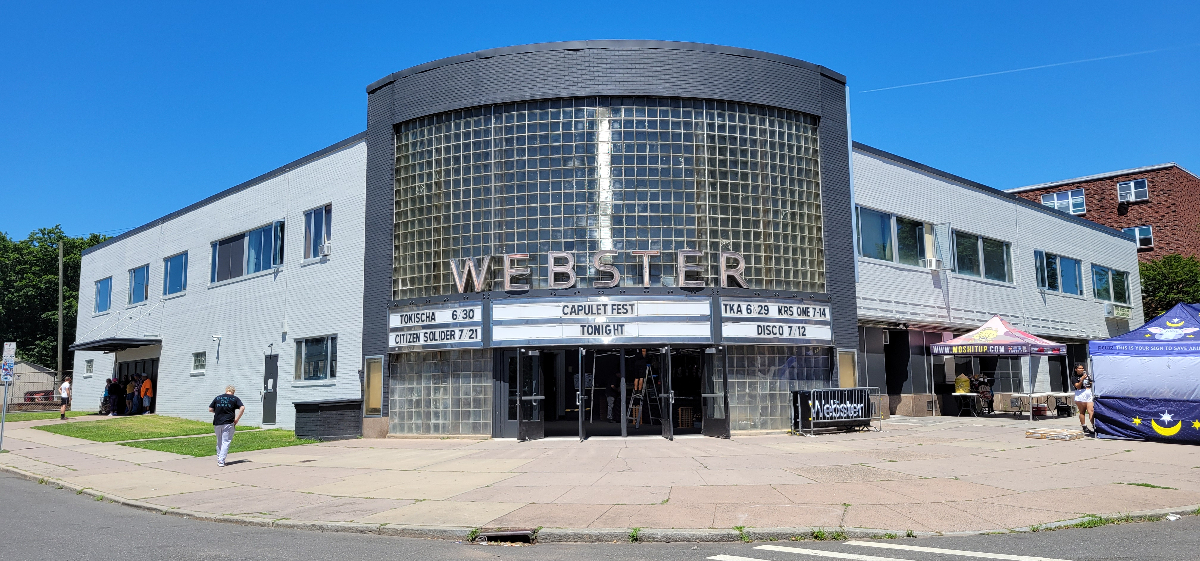
The Webster - Hartford, CT
Parking
Parking is one of the most common questions from first-time visitors to The Webster. Here is what you need to know before arriving.
• Crown Street (main lot) — paid lot next to the venue, opens ~1 hour before doors
• Behind St. Augustine's Church (secondary lot) — available when main lot fills
• Rideshare Drop-Off — main entrance on Webster St
Important Notice: Do not park on surrounding side streets. Reserved for local residents only. Carpooling strongly encouraged since parking is limited.
Public Transit
The Webster is accessible by CTtransit from downtown Hartford and surrounding Barry Square streets. Below are the most convenient routes for reaching the venue without a car.
| Route | Street | Nearest Stop |
| Route 61 | Broad St | Broad St at Webster St |
| Route 37/39 | New Britain Ave | New Britain Ave at Broad St |
| Route 43 | Campfield Ave | Campfield Ave at Webster St |
For schedules and real-time bus tracking, visit cttransit.com. From downtown Hartford, The Webster is approximately a 15-minute bus ride.
Overview
The Webster is one of Hartford's most storied live music and event venues, and a defining landmark of the Barry Square neighborhood. Located at 31 Webster Street in South Hartford, the venue has served the city in various forms since 1937. It operates two performance spaces: the main hall with a capacity of 1,300 and The Webster Underground with a capacity of 350, allowing two events to take place simultaneously.
Under current ownership by Concert Crave, The Webster books acts across a wide range of genres including rock, metal, Latin, country, hip-hop, and comedy. The venue also hosts corporate events, trade shows, podcasts, fitness events, and private parties, making it one of Hartford's most versatile event spaces.
History
The Webster Theater opened on November 19, 1937. The Hartford Courant reported at the time that it was the first theater built in Hartford since 1927 and the first designed specifically for sound pictures. The building was constructed by Albert Shulman, a recent MIT graduate, and its opening night featured a sold-out screening of "Forever Yours" attended by Hartford Mayor Thomas Spellacy.
For decades, The Webster operated as a movie house. In 1974, the building became a concert hall for the first time, though the venture lasted only a short period. The building eventually fell into decline and was shuttered from 1985 to 1995.
In 1996, Albert Shulman's daughter, Justine Robertson, reopened the venue as a live music space as part of a broader redevelopment effort for the Barry Square neighborhood. This marked the beginning of The Webster's modern era. Major acts such as No Doubt, Morrissey, Little Feat, Widespread Panic, and Megadeth performed in the venue's early years as a concert hall.
Music history was made at The Webster in 1997 when a local band from Springfield, Massachusetts named Staind performed as an opening act and caught the attention of headliners Limp Bizkit. That connection led directly to Staind's breakthrough album "Dysfunction," produced by Limp Bizkit frontman Fred Durst.
In 2009, MassConcerts purchased The Webster for $600,000. The venue became known for nationally touring rock and metal acts, though hip-hop, comedy, and themed dance parties also became regular bookings. In 2023, Concert Crave acquired the property for $1.45 million and launched a new era for the venue.
Why The Webster Matters for Barry Square
The Webster is the most recognized landmark in Barry Square. For nearly 90 years, it has drawn visitors to the neighborhood from across Hartford and beyond. Those visitors eat at local restaurants, experience local streets, and encounter Barry Square for the first time through its most famous address.
The venue also serves as an economic anchor. Concert Crave's investment creates local employment and attracts outside spending to South Hartford. The owners' stated commitment to community partnerships, including food drives and neighborhood events, reflects a recognition that The Webster's success is tied to Barry Square's own vitality.
When Justine Robertson reopened the venue in 1996, it was explicitly as part of a revitalization plan for the Barry Square neighborhood. That connection between The Webster and the neighborhood's identity has held for nearly 30 years.